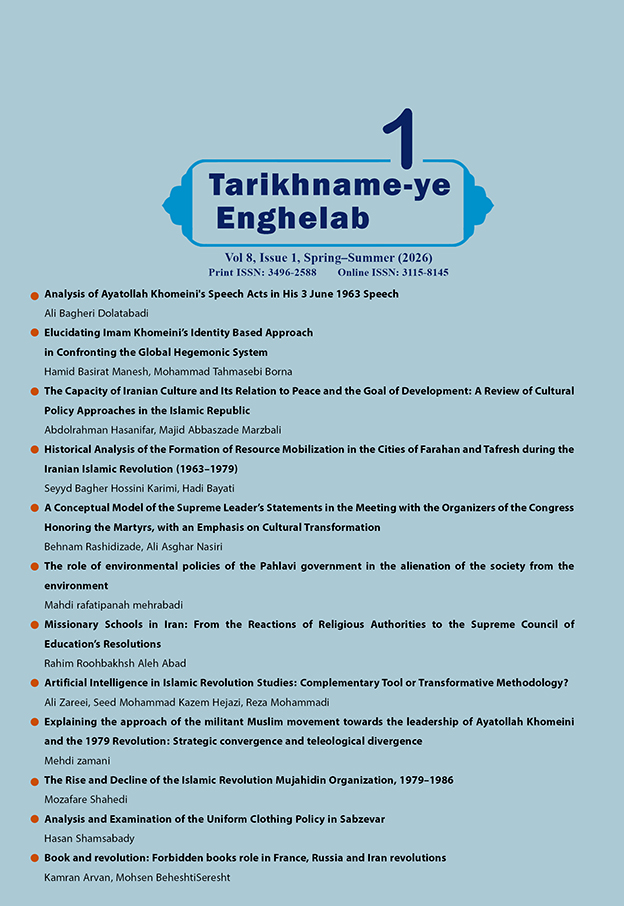
Tarikhname-ye Enghelab

Tarikhname-ye Enghelab

Keywords Cloud

  • Islamic Revolution
  • Imam Khomeini
  • Islamic Revolution of Iran
  • Islamic Republic
  • Ayatollah Khomeini
  • Iran
  • Oral history
  • Pahlavi Government
  • Ideology
  • National Front
  • clerics
  • Discourse
  • Revolution
  • Islamic movement
  • Historiography
  • Freedom Movement of Iran
  • Marxism
  • Pahlavi
  • Isfahan
  • Army
  • Constitutional Movement
  • Political Development
  • pluralism
  • party politics
  • Pathology
  • Peace
  • identity
  • Pahlavi II
  • political crisis
  • political participation
  • Mashhad
  • Theme analysis
  • Nomads
  • Modernization
  • John Searle
  • Political Thought
  • Government
  • Islam
  • freedom
  • Press
  • Reza Shah
  • Pahlavi regime
  • Mohammad Reza Shah
  • Islamic Consultative Assembly
  • Authority
  • Civil Society
  • United States
  • Egypt
  • constructivism
  • Islamic Republic of Iran
  • Religion
  • White Revolution
  • Communism
  • Islamists
  • Islamism
  • Shabir Khaghani
  • Yemen war
  • Borujerdi
  • legislation
  • Iranian Parliament
  • revolutionary
  • Islamic Revolution Studies
  • interpassivity
  • Road Construction
  • the Islamic Revolution of Iran
  • backwardness
  • National Movement
  • political explanation
  • clericalism
  • traditional middle class
  • political competition
  • the Iranian revolution
  • contemporary Iranian history
  • university
  • Islamic movements
  • Russia
  • common threats
  • Yemen
  • comparative study
  • 500 Years of the Persian Empire
  • Najaf district
  • MKO
  • Shohada Square
  • reaction
  • s (RA) Movement, Bushehr, Hojjatoleslam Abu Torab Ashuri, surveillance policies, SAVAK
  • Pierre Bourdieu
  • Liberalism
  • Chinese approach
  • Umm ar-Rasas
  • Astan Quds
  • spreading Islam
  • Bazargan
  • capitulation in Iran
  • Constitution of the Islamic Republic of Iran
  • Mojahedin Khalq Organization
  • cultural influence
  • Abd al-Azim Valian
  • elections
  • parliamentary fight
  • the Islamic revolution
  • editing standards
  • Digital Hermeneutics
  • Mujahideen of the Islamic Revolution
  • Tudeh Party of Iran
  • Revolution Council
  • Supreme National Security Council
  • Islamic awakening
  • \"؛ History of book\"
  • latent demands
  • Majlis Elections
  • Imam Ali (PBUH)
  • Shiite Authorities
  • brokers
  • Jelve Haqigat newspaper
  • the French revolution
  • propagation of authority of Imam Khomeini (RA)
  • Algiers Revolution
  • Civilization
  • Republicanism
  • Leisure
  • Transform the Land
  • Political Islam
  • Studying and Analyzing Role of Feyziyya School in Revival of Shia School of Thought
  • the Islamic Consultative Assembly
  • Ali Akbar Hakamizadeh
  • Israr Sharq newspaper
  • Taj al-Muluk
  • Farahan
  • Collected Poems of Imam Khomeini
  • Akhund Khorasani
  • personality psychology
  • Am-al-Qari
  • Gharah Baghi
  • Islamic Jurisprudence
  • Khoramshahr
  • The Pahlavi regime
  • regional rivalry
  • Alliance for Progress
  • Cultural assimilation
  • Social Situation
  • political and economic colonialism
  • Oil Shock
  • functionalistic clarification
  • Imam’s Line of Thinking
  • Bandar Kangan
  • Iran-Iraq war
  • National Liberal spectrum
  • national and religious subject
  • Speech act, leadership statements, martyrs commemoration congress, content analysis, explanation of martyrs'
  • Negative Goals
  • eclectics
  • Pan Arabism
  • legitimacy
  • Islamic Revolution values
  • SAVAK
  • Bolshevism
  • Behzad karimi
  • Religious Groups
  • Mohammad Reza Pahlavi
  • Memories
  • free education
  • religious intellectualism
  • Internationalism
  • Keywords: Imam Khomeini
  • National Assembly
  • teachers and students
  • governmental/state education
  • Governments
  • class base
  • leader\'s speech
  • Methods of Analysis
  • Kuzegari Mosque and Seminary
  • Guardian Council
  • national sovereignty
  • Experts Assembly
  • Pahlavi period
  • Muslim fighters
  • calendar
  • historiography of the Islamic Revolution
  • organization
  • Shushtar
  • infrastructure
  • Addiction
  • Sheikh Abbas Ashuri
  • Revolution of 1979
  • Health Corps
  • rational clarification
  • Center of Muslim Youths
  • Kohgiluyeh and Boyer Ahmad
  • Ayatollah Mohammad Hassan Al-e Tayyeb
  • Soviet Union
  • content
  • verses of war and jihad
  • Wahhabism
  • culture
  • Bazaar-mosque bond
  • development programs
  • Public Participation
  • the Pease Corps
  • Social Current