Document Type : Original Article
Authors
1
Associate Professor of Political Science, Imam Hossein (AS) University, Tehran, Iran. Boulevard, Imam Sadeq (AS) Islamic Sciences Research Institute.
2
Associate Professor, Department of Islamic Theology, Faculty of Theology and Islamic Studies, University of Shahrood, Shahrood, Iran.
Abstract
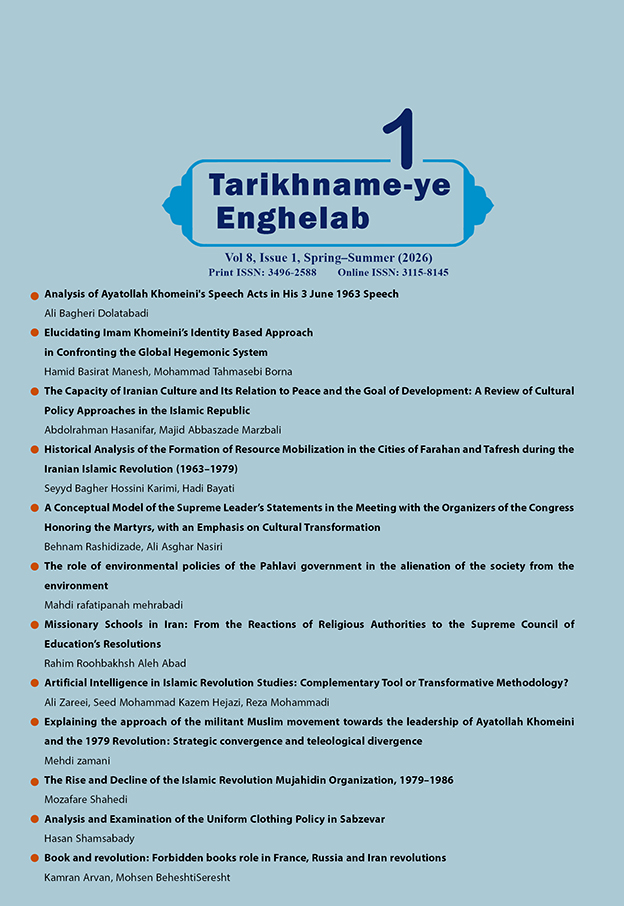
Abstract: The statements of the Supreme Leader in his meeting with the organizers of the Congress Honoring the Martyrs go beyond a symbolic address; they convey strategic guidance on preserving the legacy of the Sacred Defense, strengthening the culture of self‑sacrifice, and reproducing the collective memory of society. Despite the importance of these statements, systematic analysis and extraction of their strategic themes have received limited attention in the research literature. This study aims to develop a conceptual model of the Leader’s statements in this meeting, examining how ethical, cultural, and identity‑based values are transmitted and how they influence the guidance of social actors and the continuity of the culture of sacrifice.
This applied qualitative research employs the grounded theory method, with data collected and analyzed from official transcripts of selected statements using purposive sampling. The findings identify 17 core categories, including strengthening national‑religious identity, representing and modeling the conduct of the martyrs, safeguarding the truth of the Sacred Defense, institutionalizing the remembrance of martyrs through memoir writing and documentation, purposeful management and impact of congresses, supporting and honoring the families of martyrs, the role of youth in preserving values, promoting cultural jihad, and providing strategic frameworks for cultural policymaking.
The results indicate that the Leader’s statements in this meeting play a strategic role in consolidating the culture of sacrifice, offering ethical and identity‑based guidance to the younger generation, and reproducing collective memory. These insights can serve as a foundation for designing educational‑cultural programs, evaluating the effectiveness of martyr‑commemoration congresses, and informing cultural policy. Future research may examine the impact of these messages on audiences and quantitatively assess the outcomes of programs based on these categories
Keywords

 - سلطانی، حسن (1402). نقش فرهنگ ایثار و شهادت در اجرای مهندسی فرهنگ اقتصاد مقاومتی از دیدگاه مقام معظم رهبری (مدظله العالی). جامعه و سیاست، 1 (2)، 70-81. http://noo.rs/0j5gw