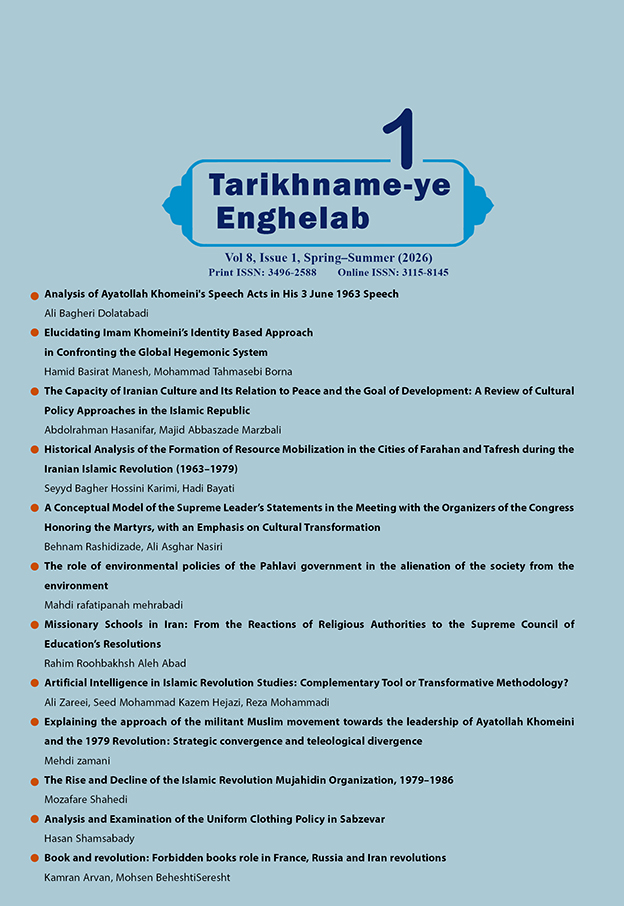
Tarikhname-ye Enghelab

Tarikhname-ye Enghelab

Current Issue: Volume 8, Issue 1, September 2026, Pages 1-307 

Keywords Cloud

  • Islamic Revolution
  • Imam Khomeini
  • Islamic Revolution of Iran
  • Iran
  • Islamic Republic
  • Oral history
  • Ayatollah Khomeini
  • Revolution
  • clerics
  • Islamic movement
  • National Front
  • Pahlavi Government
  • Ideology
  • Discourse
  • Political Development
  • Pahlavi regime
  • Freedom Movement of Iran
  • pluralism
  • Historiography
  • Army
  • Isfahan
  • Marxism
  • Constitutional Movement
  • Pahlavi
  • Mohammad Reza Shah
  • Modernization
  • Islam
  • party politics
  • freedom
  • Communism
  • Nomads
  • Islamic Republic of Iran
  • Pathology
  • Islamic Consultative Assembly
  • Mashhad
  • Press
  • United States
  • Religion
  • White Revolution
  • political crisis
  • Peace
  • Political Islam
  • Islamists
  • Authority
  • supreme leader
  • Egypt
  • Pahlavi II
  • Reza Shah
  • John Searle
  • Constitution of the Islamic Republic of Iran
  • identity
  • constructivism
  • political participation
  • Civil Society
  • Islamism
  • Theme analysis
  • Political Thought
  • Transform the Land
  • Alliance for Progress
  • Leisure
  • Borujerdi
  • Israr Sharq newspaper
  • National Liberal spectrum
  • the Iranian revolution
  • propagation of authority of Imam Khomeini (RA)
  • the French revolution
  • content
  • Jelve Haqigat newspaper
  • backwardness
  • Addiction
  • university
  • Khoramshahr
  • Shiite Authorities
  • National Movement
  • Environmental Policies
  • Majlis Elections
  • latent demands
  • Western discourse
  • Islamic movements
  • Islamic awakening
  • Public Participation
  • Shiite religious authority
  • Kohistan Seminary
  • verses of war and jihad
  • People'
  • Shohada Square
  • national and religious subject
  • Identity
  • Center of Muslim Youths
  • Digital Hermeneutics
  • Ayatollah Kohistani
  • Health Corps
  • Behshahr Muslim Youth Association
  • Mojahedin Khalq Organization
  • Cossacks
  • comparative analysis
  • Wahhabism
  • Abd al-Azim Valian
  • Currents of thought
  • Shiaism
  • elections
  • liberal nationalists
  • Neauphle-le-Château
  • strike
  • the United States
  • Forbidden books, White cover books. Iran&‌rsquo
  • concrete factors
  • Nain revolutionaries
  • Narrator
  • equality
  • Marginalists
  • Saudi Arabia
  • Behshahr City
  • criterion
  • House
  • Constitutional Revolution
  • Refah School
  • Shariat Sanglaji
  • Supreme Council of Education
  • calendar
  • holistic social engineering
  • "Imam Khomeini"
  • Ayatollah Khoei
  • social deviations
  • Khorasan newspaper
  • June 1963 Uprisng
  • parliamentary fight
  • Islamic Revolution Studies
  • Pahlavi period
  • Experts Assembly
  • Islamic socialism
  • Guardian Council
  • Prophet (PBUH)
  • national sovereignty
  • Yemen war
  • leader\'s speech
  • Intellectualism
  • cultural influence
  • changes
  • Seyyed al-Shohada Brigade 10 forces
  • teachers and students
  • capitulation in Iran
  • interpassivity
  • Liberalism
  • religious intellectualism
  • Internationalism
  • Bazargan
  • cultural homogenization
  • free education
  • political functionality
  • Behzad karimi
  • Enghalab-e Sefid
  • "deputy leader"
  • Kayhan
  • Imam Khomeini'
  • Economic Dependence
  • revolutionary mobilization
  • teleological divergence
  • Iran-Iraq war
  • Constitution
  • Americanism
  • Leader’s Office
  • Positive Ideals
  • Britain
  • religious processions
  • Women
  • Taj al-Muluk
  • local history centers
  • organizational clarification
  • Bazaar activists
  • religious wing
  • Resistance
  • private education
  • form
  • Public Diplomacy
  • Shah
  • Negative Goals
  • Coup
  • literacy level
  • Ahmad Kasravi
  • governmental/state education
  • Iraq
  • partisan politics
  • Society of Combatant Clerics
  • Government
  • Pahlavi Rule
  • Nasir Khan Mosque of Behshahr
  • charity
  • Shiite Identity
  • Iran
  • Islamic Jurisprudence
  • Missionary schools
  • Astan Quds
  • the uprising of June 3, 1963
  • Al-E Ahmad
  • boycott
  • war
  • army’s neutrality
  • Mosadeq
  • imperial calendar